
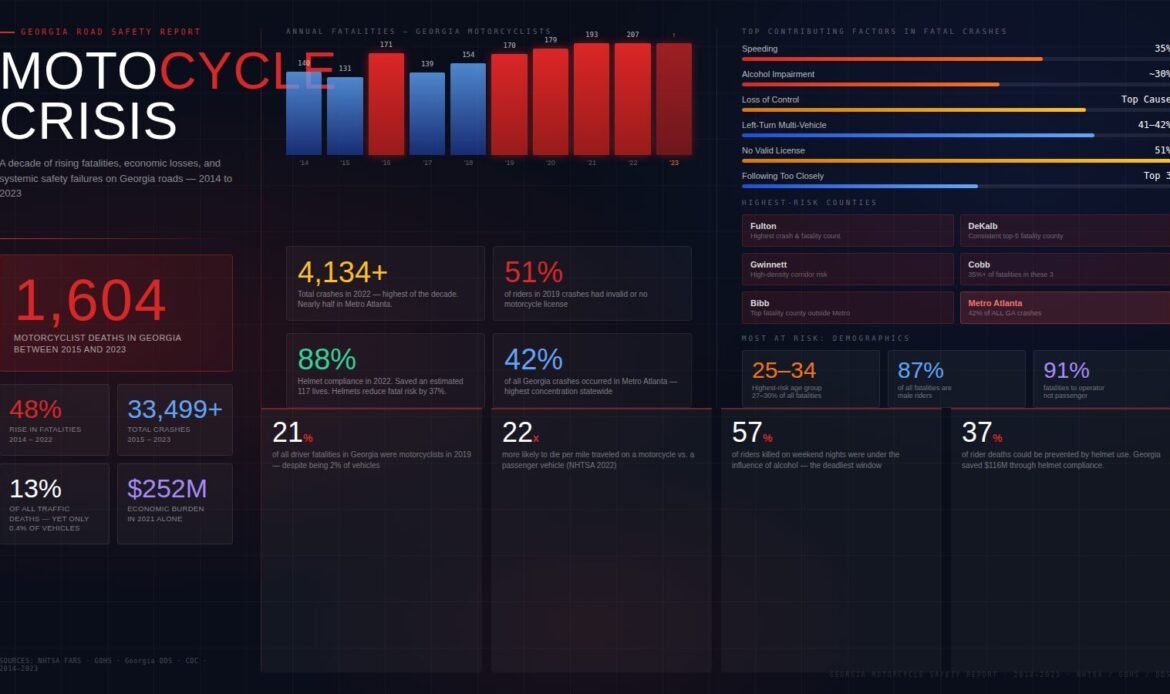
A Comprehensive 10-Year Analysis (2014–2024)
Sources: NHTSA | Georgia Governor’s Office of Highway Safety (GOHS) | CDC | Georgia DDS
Executive Summary
Over the past decade, motorcycle accidents in Georgia have followed a deeply troubling upward trajectory. While total crashes briefly dipped in 2017 and 2018, fatalities have climbed relentlessly since then. From 2014 to 2022, motorcyclist deaths in the state increased by nearly 48%, rising from 140 to 207 confirmed fatalities. In that same period, Georgia recorded more than 33,499 motorcycle crashes resulting in 1,604 deaths, according to data compiled from NHTSA and the Georgia Governor’s Office of Highway Safety (GOHS).
Despite motorcycles representing just 2% of registered vehicles in Georgia and being involved in only 1% of all motor vehicle crashes, they now account for nearly 13% of all traffic fatalities statewide. This disproportionate impact makes motorcycle safety one of the most urgent public road safety issues in Georgia today.
Year-by-Year Fatality and Crash Data (2014–2023)
The table below compiles verified data from NHTSA’s Fatality Analysis Reporting System (FARS), GOHS annual reports, and the Georgia Department of Driver Services (DDS):
| Year | Fatalities | Total Crashes | % Change in Fatalities | Key Note |
| 2014 | 140 | ~3,100 | Baseline | Baseline year |
| 2015 | 131 | ~3,050 | -6% | Brief decline; state bucked national trend |
| 2016 | 171 | 3,122 | +30% | Deadliest year of mid-decade; 22% of all driver fatalities |
| 2017 | 139 | ~2,970 | -19% | Temporary improvement following safety campaigns |
| 2018 | 154 | 3,049 | +11% | Decade low in total crashes; fatalities rebounded |
| 2019 | 170 | 3,948 | +10% | 30% spike in crashes; 51% of riders lacked valid license |
| 2020 | 179 | ~4,000 | +5% | COVID-era riskier behavior; 8% fatality rise |
| 2021 | 193 | 4,085 | +8% | Economic burden hit $252M; 8% fatality increase |
| 2022 | 207 | 4,134+ | +7% | Deadliest year on record; nearly 13% of all traffic fatalities |
| 2023 | Rising trend | 4,200+ | TBD | Most recently published data shows continued climb |
Note: Some annual crash totals are approximate due to rounding in source reports. Fatality figures are sourced primarily from NHTSA FARS and GOHS annual publications.
Trend Analysis: A Decade in Three Phases
Phase 1: Volatility and Decline (2014–2018)
The first phase of the decade showed no clear direction. After recording 140 fatalities in 2014, Georgia saw a 6% drop to 131 in 2015, briefly moving against the national trend where fatalities rose 10% that same year. However, 2016 brought a severe reversal: fatalities surged 30% to 171, with motorcycles accounting for 22% of all driver fatalities statewide, even though they represented only 2% of registered vehicles.
2017 offered temporary relief, dropping back to 139 fatalities following increased safety enforcement. But 2018 saw fatalities climb again to 154, despite recording the decade’s lowest total crash count of 3,049. This disconnect between total crashes and deaths indicated that crashes were becoming more lethal, not just more frequent.
Phase 2: Accelerating Crisis (2019–2021)
Beginning in 2019, Georgia entered a prolonged and escalating safety crisis. Total crashes spiked 30% in a single year from 3,049 to 3,948, with 4,269 motorcyclists involved. Fatalities rose to 170, representing 11% of all traffic deaths. A critical red flag from GOHS that year: 51% of motorcyclists involved in crashes were riding with an invalid or no motorcycle license.
The COVID-19 pandemic amplified the danger in 2020 and 2021. With fewer vehicles on roads, remaining drivers engaged in riskier behavior, including higher speeds and more impaired driving. Fatalities rose to 179 in 2020 and jumped again to 193 in 2021, an 8% increase. The economic burden of motorcycle-related hospitalizations and emergency room visits hit $252 million in 2021, the highest recorded during this period.
Phase 3: Record Highs (2022–2023)
By 2022, Georgia was recording its deadliest year for motorcyclists in recent history. Fatalities climbed to 207, a 7% increase from 2021, with more than 4,134 total crashes statewide. Nearly half of all crashes occurred in Metro Atlanta. Motorcycle accidents now represented nearly 13% of all traffic fatalities, even as motorcycles made up just 0.4% of all registered vehicles in the state. As of 2025, 2023 data remains the most recently published and indicates the fatality trend continues upward.
Key Statistics at a Glance
| 33,499+ | Total motorcycle crashes in Georgia from 2015 to 2023 (NHTSA/GOHS) |
| 1,604 | Motorcyclist deaths in Georgia from 2015 to 2023 |
| 13% | Share of all Georgia traffic fatalities attributed to motorcyclists in 2022, despite motorcycles being <0.4% of registered vehicles |
| 48% | Increase in motorcyclist fatalities from 2014 (140) to 2022 (207) |
| 42% | Share of all Georgia motorcycle crashes occurring in the Metro Atlanta region |
| $252M | Economic cost of motorcycle-related hospitalizations and ER visits in Georgia in 2021 |
Contributing Factors
1. Speeding
Speeding has consistently been one of the top three contributing factors in fatal motorcycle crashes throughout the decade. Data from NHTSA shows that 33% of all fatal motorcycle crashes in Georgia in 2016 involved a speeding rider, compared to 19% for passenger car drivers. By 2022, nationally, 35% of all motorcycle riders in fatal crashes were speeding. Georgia data mirrors this trend, with speeding cited as a top contributing factor alongside loss of control and following too closely.
2. Alcohol Impairment
Alcohol has played a persistent and deadly role in Georgia motorcycle fatalities. In 2019, 12% of motorcycle operators involved in fatal crashes had a confirmed BAC of 0.08 or above, and 52% had unknown or unreported BAC levels, suggesting underreporting may mask the true scale of alcohol involvement. By 2022, GOHS data indicates nearly 30% of fatal motorcycle crashes in Georgia involved alcohol impairment. Nationally, motorcycle riders are more likely to be alcohol-impaired in fatal crashes than any other type of motor vehicle driver. On weekend nights specifically, 57% of riders killed in single-vehicle accidents were under the influence.
3. Unlicensed and Undertrained Riders
One of the most striking and persistent red flags in Georgia motorcycle data is the rate of unlicensed riding. In 2019, GOHS found that 51% of motorcyclists involved in crashes had an invalid motorcycle license, with 7% riding with no license at all. This despite the fact that Class M license holders represent only 6% of all licensed drivers in the state. Over half of fatalities in recent years have involved riders without valid motorcycle licensing, pointing to a major gap in training and enforcement.
4. Multi-Vehicle Left-Turn Crashes
In multi-vehicle accidents, a particularly dangerous and recurring pattern involves a passenger vehicle making a left turn while a motorcyclist is traveling straight or overtaking another vehicle. This scenario accounts for 41% to 42% of all fatal multi-vehicle motorcycle crashes in Georgia, consistent with national NHTSA findings. The small size of motorcycles makes them difficult for turning drivers to detect, especially at intersections with limited visibility.
5. Road Type and Location
More than 50% of fatal motorcycle crashes in Georgia occur on non-interstate roads, with a significant proportion on rural highways and two-lane roads. Yet urban areas still see the highest overall crash volumes. Metro Atlanta accounts for 42% of all crashes, and Fulton, DeKalb, Gwinnett, Cobb, and Bibb counties consistently rank as the highest-risk areas for both crashes and fatalities.
Who Is Most at Risk: Demographics
Georgia motorcycle data reveals consistent demographic patterns across the decade:
- Gender: Male riders account for 87% to 93% of all motorcycle crash fatalities and injuries. Female riders and passengers represent a small but real portion of those affected.
- Age: Riders aged 25 to 34 are the most commonly involved in crashes and fatalities, accounting for roughly 27% to 30% of all motorcycle crash fatalities. Riders aged 35 to 44 represent the second-highest risk group.
- Operators vs. Passengers: 91% of all motorcycle fatalities and injuries in Georgia are to the motorcycle operator. Only 5% of injury victims are passengers.
- Licensing: As noted above, unlicensed or improperly licensed riders are significantly overrepresented in crash data across the full decade.
Helmet Use: A Proven Lifesaver
Georgia has one of the most comprehensive helmet laws in the nation, mandating helmet use for all riders under O.C.G.A. § 40-6-315 since 1969. The data confirms helmets save lives:
- In 2022, approximately 88% of Georgia motorcyclists who were involved in accidents were wearing helmets, saving an estimated 117 lives.
- NHTSA estimates that helmets reduce the risk of fatal injury by 37% for motorcycle operators and 41% for passengers.
- Helmet use by Georgia riders saved an estimated $116 million in economic costs, according to GOHS data.
- Despite Georgia’s strict law, unhelmeted fatalities increased 21% in 2022 compared to 2021, from 14 to 17 deaths.
These figures underscore that while the law drives high compliance, enforcement gaps and non-compliant novelty helmets remain a danger.
Economic Impact
The financial toll of motorcycle accidents in Georgia has risen steadily alongside the human cost. The economic burden of motorcycle-related hospitalizations and emergency room visits climbed from $210 million in 2018 to $252 million in 2021. In 2022, that figure exceeded $230 million. These costs include medical care, lost productivity, legal proceedings, and long-term disability expenses.
The highest costs are concentrated among riders aged 25 to 34, who account for 27% of emergency room visits and 25% of hospitalizations. Given that this is also the most crash-prone age group, targeted interventions for younger riders carry the strongest potential for both human and economic savings.
State Safety Initiatives
Georgia has maintained several ongoing programs to combat motorcycle fatalities throughout the decade:
- Georgia Motorcycle Safety Program (GMSP): Operated under the Georgia Department of Driver Services, the GMSP provides crash-avoidance skills training to riders of all experience levels. Participation in the program qualifies riders for reduced insurance rates and, in some cases, waived licensing tests.
- GOHS Enforcement Campaigns: The Georgia Governor’s Office of Highway Safety runs targeted enforcement campaigns focused on impaired driving, unlicensed riding, and speeding on high-crash corridors.
- Helmet Compliance Outreach: GOHS and law enforcement agencies partner on awareness campaigns to educate riders on DOT-compliant helmets and the danger of novelty headgear.
- 2025 Programs: As of 2025, awareness campaigns focus specifically on alcohol-impaired riding and unlicensed operation, both identified as persistent contributors to fatalities.
Despite these efforts, fatality numbers have continued to rise, suggesting that enforcement and education alone may be insufficient without structural road improvements and stricter licensing requirements.
Conclusion
The data is unambiguous: Georgia’s motorcycle accident crisis has deepened substantially over the past decade. From 2014 to 2022, fatalities rose nearly 48%, total crashes increased sharply, and the economic burden crossed a quarter-billion dollars annually. Motorcyclists continue to bear a disproportionate share of traffic deaths, representing 13% of all fatalities while comprising less than 0.5% of registered vehicles.
The decade’s data points to a clear set of recurring causes: speeding, alcohol impairment, unlicensed riding, and multi-vehicle left-turn collisions. Addressing these root causes through improved licensing enforcement, rider education, road design, and public awareness campaigns will be essential to reversing a trend that has cost more than 1,600 Georgians their lives in under a decade.
For injured riders and their families, understanding these patterns is also critical to navigating insurance claims and legal proceedings. Georgia law provides meaningful protections for crash victims, but the legal landscape is complex. Those affected by motorcycle crashes are strongly encouraged to consult qualified legal counsel familiar with Georgia’s traffic and personal injury statutes.
Data Sources
- National Highway Traffic Safety Administration (NHTSA) • Fatality Analysis Reporting System (FARS), 2014–2023
- Georgia Governor’s Office of Highway Safety (GOHS) • Annual Traffic Safety Reports, 2014–2023
- Georgia Department of Driver Services (DDS) • 2019 Motorcycle Traffic Safety Facts Sheet
- Centers for Disease Control and Prevention (CDC) • Motorcycle Crash Data
- TRIP National Transportation Research (2023) • Georgia Traffic Fatalities Surge Report